

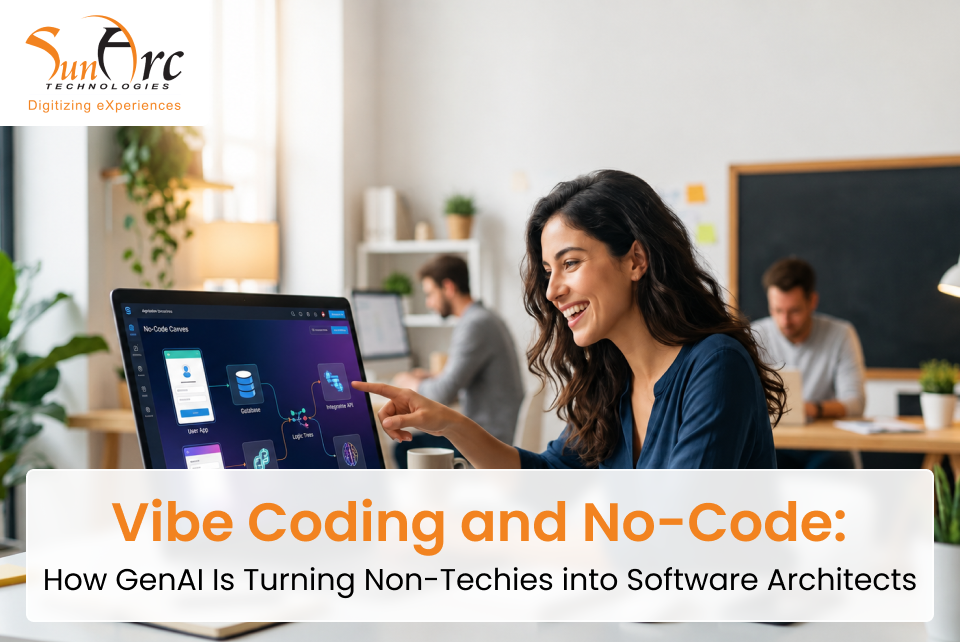
A silent revolution is taking place in the world of software, and it’s nothing like what we expected. It’s not being born in Silicon Valley campuses or MIT labs. It’s taking place in living rooms and coffee houses and co-working spaces — anywhere that someone with a laptop, an idea, and no coding experience has decided to stop waiting for a developer and just build the thing herself. Welcome to the age where you can vibe code and no-code.
What Is Vibe Coding, Exactly?
Vibe coding is a style of prompting generative AI to code in full applications using only natural language. It’s a surrender to the vibes, a gaping surrender to exponential AI power, and a near era sure that raw source code even exists. You write a sentence; the AI writes a complete, working feature.
This has ushered in an epochal paradigm. Traditional coding was always about syntax—how much you knew about commas, brackets and loops determined your success. Vibe coding, on the other hand, is results-focused. It prioritizes intent, logic and systems flow, above all else.
But this change of guard takes a giant twist which few foresaw. When Generative AI does all the raw code generation 100%, the non-technical user isn’t merely a faster creator. You are automatically promoted. You aren’t a programmer anymore; you are all of a sudden a Software Architect.
The code may be free, but logic still costs. To create production quality software that doesn’t collapse under its own weight, non-techies can’t just “vibe.” They need to think like systems engineers.
| [Traditional Development] —> Focus: Syntax, Compilers, Debugging [Vibe Coding Era] —> Focus: Intent, System Flow, Outcomes |
1. The Evolution: No-Code vs. Vibe Coding
To really understand the magnitude of this change, we need to see where we came from. For the past 10 years, tech’s democratizing wave was the No-Code/Low-Code movement. Platforms like Bubble, Webflow, and Zapier pledged to dismantle the barriers of software development.
| Dimension | Traditional No-Code Platforms | The Vibe Coding Era (GenAI Agents) |
| Interface | Visual drag-and-drop canvases | Natural language prompts & AI chat |
| Flexibility | Rigid, platform-specific ecosystems | Bespoke, portable, full-stack code |
| Scalability | Hard ceilings on complex logic | Theoretically infinite; limited only by architecture |
| Core Skill | Learning platform-specific UI | Clear communication & logical design |
Traditional No-Code has removed massive barriers, but brought with it a set of invisible shackles. Users were limited to predefined visual elements and their platform-specific industries were closed. If a platform lacked a certain plugin or data model, you hit a wall.
Enter the Vibe Coding Revolution. Through sophisticated AI coding agents such as Cursor, Replit Agent, Claude Code, and Lovable, the visual canvas has been substituted for a blank chat bar. Rather than lifting a box to indicate a database, you tell the story. These bots don’t just emulate software; they create custom production grade full stack infrastructure on the fly. They provision databases, write backend logic, configure APIs, and deploy the frontend.
But this sensational speed comes with a fatal trap: The “Vibe Gap.”
Since AI makes generation seem so easy, It’s really easy to go faster than you understand. You can make anyone call 500 lines of perfect Python or React components in ten seconds. But if you don’t know how those lines connect to a database or how information moves between services, you’ll wander for a while. Velocity without architecture leads to code-as-paperweight, rapidly-inline-and-break-then-rush-code bases full of fragile and ultimately unmaintainable complexity. Closing the Vibe Gap demands immediate architectural thinking.
2. The Thematic Focus: The Micro-SaaS Solo Founder
Let’s take these abstract concepts and put them into a real-world scenario. Meet Sarah, a product marketer who isn’t technical. She has identified a market opportunity and would like to build a niche Micro-SaaS product: An Automated SEO Content Auditor.
| [User Inputs URL] ➔ [Background Web Crawler] ➔ [GenAI Analysis] ➔ [PDF Generator] ➔ [Email Delivery] |
Sarah’s vision for the app workflow is simple:
- A user logs in, inputs their website URL.
- The app starts a crawl of the site.
- The app takes that raw information and feeds it to a Large Language Model (LLM) that identifies content gaps.
- It ties those insights together into a slick PDF report.
- The system automatically emails the user that pdf report.
Sarah doesn’t know how to write an express api route, or use server-side pdf generation libraries. In the vibe coding era, she doesn’t have to. All she has to do now is to plot out the plan for the app. And if she can’t explain how the web crawler, the database, the LLM, and the email server fit together systemically, the AI will spit out a broken product. Sarah has to be a woodlover; rise as the architect.
3. The 4 Pillars of “Vibe Architecture”
In order to make the leap from non-techie to Vibe Architect, you need to have a solid understanding of 4 foundational pillars of software architecture — spoken in plain English, not gobbledygook.
a) Data Modeling (Where does the stuff live?)
- The Concept: Data modeling is a way of organizing data so that an application can logically process information, store it, retrieve it and update it if needed, without causing data corruption or slowing down performance. You don’t have to learn SQL syntax, but you do have to understand relational logic.
- An Actually Example: Sarah isn’t going to train·the AI to “save user info and reports somewhere” for her SEO Auditor. She has to explicitly specify the relational schema in her prompts:
“AI, install a PostgreSQL database. Make a User table. Make a Websites table related to User. Then make Audit Reports table with a one-to-many relationship with Websites, that is multiple historical reports can be generated for a single site over time.”
b) State management flow: (What happens and when?)
- The Concept: Software runs in time and state Some actions are immediate (synchronous), others take time and they do their thing in the background (asynchronous). A synchronously executing long task blocks the app and makes it unresponsive.
- The Real World Example: If you just run a site and hook it up to an LLM it can easily take three to five minutes. If Sarah builds the app to have the user wait on that screen while this is happening, her web browser will time out and die. Sarah, as an architect, designs an asynchronous queue:
“Change the application state to ‘Processing‘, when a user clicks ‘Run Audit’.” Save the audit request to a background queue, immediately show the user a loading dashboard with a progress bar >, run the crawler script silently in the background, and send an automated email to the user once the state switches to ‘Completed’.”
c) API Integrations & Boundary Lines (How do systems talk?)
- The Idea: Today there’s probably an API for everything, and apps make use of endless third-party APIs to do their heavy lifting (such as payments or pulling data). A great architect has a very clear separation between their application and the external environments, anticipating exactly how to handle “breakage”.
- The Real-Life Example: Sarah’s app uses the Google Search Console API for data and Stripe for subscription billing. She needs to give her AI agent very rigid operational guardrails and conditional error handling:
“Before you run the OpenAI API Script to analyze the content, get user’s subscription status using the stripe api webhook. Should Stripe return a payment failure or cancellation status, stop the workflow immediately, do not call the OpenAI api, and redirect the user to the billing update screen.”
d) The “Vibe Check” (Testing & Guardrails)
- The Idea: Software validation is now. It’s no longer just about throwing up messy code on the wall to see if it sticks or runs. Vibe checking also takes the form of asking AI to generate automated unit tests, so that future feature updates do not inadvertently break core logic.
- Real Life Use case: Sarah must ensure 100% data privacy that User A can never see User B’s trade secret SEO audits. She orders her AI agent to write explicit automated guardrails:
“Write a backend integration test for the report download endpoint. It should check that an unauthenticated user or a user who doesn’t own the particular site record won’t be able to visit an Audit Reports URL string for that site, and returns a 403 Forbidden error.
4. The Shift in Skills: What Matters Now?
The democratization of software has thoroughly rewritten the developer’s resume. The skills that once commanded premium salaries are rapidly commoditizing, while soft design skills are experiencing a massive surge in value.
| [ LEGACY SKILLS: OUT ] | [ MODERN SKILLS: IN ] |
| – Syntax Memorization | – Problem Decomposition |
| – Debugging Semicolons | – Prompt Specification |
| – Manual Environment Config | – Logical Boundary Setting |
This fundamental shift has fundamentally altered the standard corporate “Productivity Stack.” Historically, a non-technical product manager or founder spent weeks compiling a massive, static 10-page Product Requirement Document (PRD). They would hand this giant text document over to an engineering team and pray that the final product matched their initial vision months later.
Today, the PRD is the application. Because Vibe Architects use natural language to direct AI agents, the act of writing clear, logically sound, highly detailed specifications is the exact same act as writing the application itself. Prototyping has become entirely interactive, real-time, and collaborative.
5. The Counter-Perspective: The Dangers of Pure “Vibe“
The democratization of software architecture is exciting, but a naïve entrance into that space is going to get you hacked on a daily basis. Pure vibe coding introduces catastrophic systemic risk that every team has to constantly wrestle with.
The main pitfall is the confidence problem. When an AI agent creates 10,000 lines of code behind a perfect user interface, the developer feels brilliant until the code breaks in production. If you don’t know anything about the underlying tech stack, tracking down a silent database leak or a security hole is impossible.
Also enabling itself in a way that generates huge amounts of technical debt and security holes. AI optimization models are engineered to give you what you ask for fastest, which doesn’t always mean safest. An AI agent without guidance could potentially ignore cross-site scripting (XSS) protections and commit sensitive API keys straight into front-end files or similar.
| [ THE HYBRID DEVELOPMENT TEAM ] ┌─────────────────────────────────────────┐ │ Business Stakeholders / │ —> Drives vision, logic, │ “Vibe Architects” │ and user workflows └────────────────────┬────────────────────┘ ▼ ┌─────────────────────────────────────────┐ │ Professional Software Engineers / │ —> Reviews system design, sets │ “Guardrail Builders” │ security & monitors scale └─────────────────────────────────────────┘ |
The future of software development is a hybrid approach. Professional software engineers are not going away; rather, their roles are being elevated. They are taking on roles as “Vibe Reviewers” and “Guardrail Builders.” They are going to write the core infrastructure, manage data security policies, and handle system scalability and more. Nontechnical business stakeholders the new Vibe Architects can take advantage of that secure sandbox to instantly create, test and deliver features faster than anyone could have imagined.
Conclusion & Actionable Takeaways
Generative AI has democratized coding, but also created a superpower for top-end system design. “Code syntax is cheap; cultivating clean, logical solutions for humans is the zen ultimate differentiator.”
If you’re a non-technical creator, founder, or executive, you can stop watching from the sidelines of tech innovation. You’re promoted to Software Architect. The kits are assembled, the AI agents are waiting–and the only thing preventing you from diving in is the opacity of your own systems thinking.
YOUR NEXT STEP: Start thinking about your app idea less as a vague list of shiny features. So grab a seat today, start up with a blank page or digital whiteboard, and draw out the flow of your data. Build your tables, design your third party api boundaries and define your background jobs. With good architectural sense, open Cursor or Replit Agent and script out your infrastructure. Build something that lasts. Can’t wait to see your next building engineered by Vibe Architects!