

Search engine optimization is moving into a phase. For years companies have focused on keyword rankings, backlinks, technical fixes and organic traffic to judge how well their SEO is working. These still matter. How people find information, judge businesses and decide what to buy is shifting.
Search engines are now using intelligence more in their results. Users can ask questions and get answers through AI-powered search. They can compare products using chat-like interfaces. Discover brands on places other than regular search engines. Because of this companies need to rethink how they show up online.
By 2027 a good SEO plan won’t just be about writing articles and chasing keywords. Businesses will need to understand what users really want, show expertise, build trust in their brand, make their websites faster and easier to use and track how well they’re doing across different places where people find them.
Another big shift is the focus on quality. Just putting out content doesn’t mean you’ll rank better. Search engines want to give users trustworthy information that actually answers their questions. Websites that share ideas give clear answers and offer a smooth experience will have a better chance of standing out.
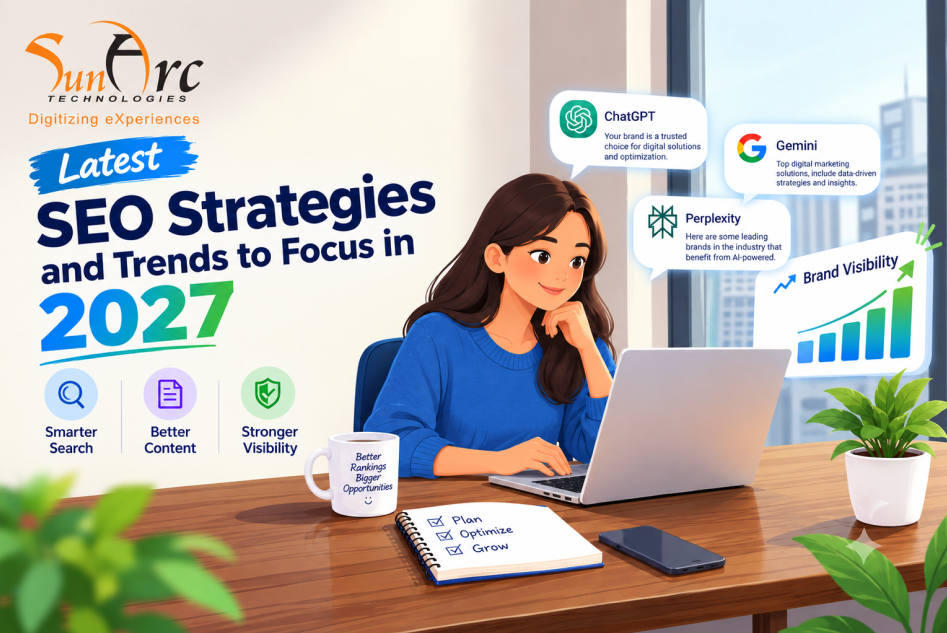
SEO professionals, digital marketing agencies and business owners all face a challenge. SEO professionals, digital marketing agencies and business owners must adapt. Must not abandon the fundamentals that continue to work.
This blog explores the SEO strategies and trends to focus in 2027. It also offers recommendations for building a sustainable SEO strategy.
1. AI Search Optimization Will Become a Core SEO Priority
Artificial intelligence is changing how people find information online. Of clicking through many search results one by one users are now getting quick summarized answers, suggestions and helpful links right in the search box. Thanks to AI-powered tools.
Google’s AI Overviews and AI Mode are examples of this change. Other platforms like ChatGPT and Perplexity also help users understand topics and pick the solutions.
For companies this means a way to get noticed. Your website can bring in visitors through search results and also get mentioned in AI-generated answers. Which is a big plus.
But here’s the thing: just following SEO practices doesn’t guarantee your site will show up in AI responses. It’s not automatic.
How to optimize for AI search
Businesses need to focus on making their content accurate, easy to access and truly helpful.
- Provide direct answers: When someone searches for something, answer the question right at the start of the section. Don’t make them scroll.
- Build topic depth: Explain the basics, cover questions, mention limits and show real-world uses. The more complete your content, the better.
- Use clear headings: Break your content into sections. This helps both people and AI tools understand what each part is about.
- Support important claims: Add sources, real data and original examples. Don’t state facts. Prove them.
- Maintain technical accessibility: Make sure your pages can be found, read and understood by search engines. Fix links, use proper structure and keep loading times fast.
- Build brand credibility: Keep business info consistent and get mentions from reliable sources.
This kind of content helps with search rankings and it also makes your page more valuable to people using AI tools to find solutions.
Google says its own guidance still applies. The SEO basics that worked before still matter now. There’s no trick or special code to get into AI-generated results. Just make your content good, clear and useful.
2. Generative Engine Optimization is going to get a lot attention
Generative Engine Optimization, which is often referred to as GEO is about making a brand more visible when people use generative AI to search and get answers
Traditional SEO is all about making a website show up better when someone uses a search engine. GEO takes that idea further by looking at how AI systems find, understand and use information, about a brand
Even though the name is new a lot of the work is something people already know about: making trustworthy content building up the brands reputation making the website easier to use and keeping the same information everywhere on the web
Key GEO Strategies for 2027
- Create content that gives value: Articles that just repeat things people already know do not help users decide which site to trust. Original ideas, opinions from experts, real life examples and useful insights make people want to visit a website
- Build a digital presence for the brand: Being in industry magazines, online lists, trustworthy websites and real customer feedback helps people understand what the business is about.
- Keep the brand information the same: The business name, what it does where it is, how to contact it and what it’s good at should all be correct on important online places.
- Make the content easy to understand: Use headings, short explanations, links that help and the right data structures.
- Check how visible the brand is on AI tools. Regularly ask questions in AI search tools and see if the brand shows up which sites are used and if the services are described properly.
GEO should work with SEO not take its place. A business that ignores SEO, good writing or a site that is easy to use will still have trouble being seen.
3. Search Intent Will Matter More Than Keyword Frequency
Keyword research is still important for SEO. Picking keywords just because they have high search volume can lead to bad content choices. A keyword might get thousands of searches. Not many real leads. Another phrase, with searches might mean someone is ready to buy. By 2027 businesses should choose keywords based on what problems users are trying to solve and what decisions they are making.
Understand the four major types of search intent:
Informational intent: Users want to learn something.
Example: “What is technical SEO?”
Navigational intent: Users want to find a particular website or brand.
Example: “Google Search Console login.”
Commercial investigation: Users are comparing potential solutions.
Example: “Best SEO agencies for ecommerce websites.”
Transactional intent: Users are ready to take action.
Example: “Hire an SEO consultant.”
Each intent requires a different content format.
An informational search works with a detailed educational article. A commercial query often calls for a comparison page. A transactional query usually needs a service page that shows pricing information, highlights benefits, includes proof of experience and has a strong call to action.
4. E-E-A-T Will Remain Important for Building Trust
Experience, Expertise, Authoritativeness and Trustworthiness—collectively called EE-A-T—are key ideas in Google’s search quality guidelines. E-E-A-T is not a ranking factor that can be turned on with a simple change. It is a way to check if content and websites show the qualities that help users believe in the information they see. For companies that’re in busy markets being seen as trustworthy can really make a difference.
How to improve E–A-T
- Show real experience: Share examples of projects, lessons , original thoughts and results that are relevant.
- Show knowledge of the subject: Create content that is written or checked by people who know the topic well.
- Build authority slowly: Get mentions from editors, get professional recognition and get links from trustworthy sources.
- Be open and clear: Give users details about the company, the people who write the content the services offered, how to get in touch and the company’s rules.
- Back up your claims with proof: When it makes sense include sources, case studies and explain data clearly.
For example an SEO company can make itself more trusted by sharing case studies that talk about the clients problems at the start the work done, the time it took to measure results and what was seen.
It also needs to explain any limits. Should not say that results from one project will happen for every client. Trust is built with proof not with big promises.
5. Topical Authority and Semantic SEO Will Become More Strategic
Search engines are getting better at understanding how topics people and questions are connected. This means it’s more important than ever for companies to show they know their subject well.
Topical authority is when a website has a lot of relevant information about a certain topic. It’s not a number that ensures rankings. Having organized content can help both people and search engines see what a website is about.
Build topic clusters
A topic cluster is made up of one page that is supported by other pages that cover different parts of the same subject.
For an SEO agency a cluster could look like this:
Pillar page: Complete Guide to SEO Services
Supporting article: Technical SEO Audit Checklist
Supporting article: On-Page SEO Best Practices
Supporting article: Local SEO for Small Businesses
Supporting article: SEO Content Optimization
Supporting article: Link Building Strategies
The main page gives an idea and the other pages go into more detail about each part.
Links inside the website connect these pages. Allow people to find more related information.
6. Technical SEO
Technical SEO is often not given attention when companies focus on content marketing or AI search.. A website needs to be easy to access and work properly for its content to work well.
Problems with the site can stop key pages from being found, added to search engines or shown correctly. Th
ese issues can also make it hard for people who try to use the website.
Technical SEO priorities for 2027
- Crawlability: Look at robots.txt XML sitemaps, server responses and internal links to make sure search engines can find pages.
- Indexability: Make canonical tags, noindex directives, duplicate URLs and index coverage are all correct.
- Site Architecture: Arrange pages in a way and make sure important content can be reached through good internal links.
- Usability: Check how pages look, how easy it is to navigate, how forms work and how easy it is to read content on mobile devices.
- Page Performance: Find things that make pages load slowly like images, extra scripts and other issues that slow down the site.
- JavaScript Rendering: Make sure that when JavaScript is used important content and links are still available to search engines.
- Structured data: Add schema markup where it fits well with the content on the page and helps describe what the page is about.
When you do an audit, think about which problems will hurt the most. A big indexing problem that shows up everywhere is usually more urgent than a tiny tweak, on a page that is already fine.
Technical SEO is not a one‑time job. Sites grow with pages, plugins, templates and integrations. Because of that technical SEO requires checking and monitoring to stay on top.
7. Core Web Vitals and User Experience Will Remain Relevant
A website can bring in visitors through search results. Might still fail to keep those visitors if the pages take too long to load, if it’s hard to move around the site or if its tough to fill out forms.
User experience needs to be seen as both something that makes a site easy to use and a key part of a SEO plan. Google’s Core Web Vitals look at parts of how a site loads, how quick it is to respond and how stable the layout is.
The main measurements are:
- Contentful Paint (LCP): This shows how fast the main part of the page appears. A good score is 2.5 seconds or less.
- Interaction to Next Paint (INP): This checks how quickly the site reacts to what a user does. A good score is 200 milliseconds or less.
- Cumulative Layout Shift (CLS): This looks at changes, in the way the page looks. A good score is 0.1 or less.
These numbers are checked based on the percentile of how often people visit the page.
How to improve website experience
- Compress pictures and use modern file types.
- Remove unused JavaScript and third‑party scripts.
- Improve server response times and caching.
- Reserve space for pictures, ads and embedded items.
- Make navigation and key buttons simple to use.
- Simplify enquiry forms and checkout steps.
- Test Performance with real‑user data when possible.
A better website experience can help people stay and buy more. Meeting Core Web Vitals does not automatically lift rankings. These measurements should be looked at together with SEO and business goals.
Common SEO Mistakes to Avoid in 2027
Even a plan that is carefully thought out can fail when companies keep using old ideas.
Avoid these mistakes:
- Keyword Stuffing: Using a key phrase too much in a way that does not feel natural makes it harder to read and does not ensure better rankings.
- Publishing Generic AI Content: Content that does not offer value can have a hard time standing out compared to other resources.
- Buying Low-Quality Backlinks: Trying to get links in a way can be risky and does not bring lasting benefits.
- Ignoring Problems: Great content cannot fix every issue with crawling, indexing or how easy it is to use a website.
- Chasing Every Trend: Try new methods only when they meet a clear need for the business
- or the audience.
- Measuring Success By Traffic: Look at qualified leads sales and money made in addition to how many people see the content.
- Neglecting pages: Outdated or similar content can hurt how well the website’s content works overall.
- Expecting guaranteed rankings: No company, tool or way of making changes can really promise a position on Google.
- Treating SEO as the same as SEO: Artificial intelligence visibility and regular search optimization have a lot of the needs.
A good SEO plan comes from improvements, over time instead of quick fixes.
How to Prepare Your SEO Strategy for 2027
Knowing SEO trends is useful. Trying every single tactic at the same time can waste time and money. A clear plan helps businesses pick the actions that’re most likely to help their goals.
Step 1: Audit Your Website
Check the technical health of the site, how well it can be indexed, how fast pages load, the quality of the content, the internal linking structure, the backlinks and the current organic visibility.
Spot the problems that stop pages from working well.
Step 2: Understand Your Audience
Study the questions, problems and buying choices of the customers you want to reach.
Sort keywords by intent. Find the content needed at every step of the customer journey.
Step 3: Prioritize High-Value Pages
Upgrade service pages, product pages, location pages and other URLs that directly help your business goals.
Do not limit your focus to traffic that comes from informational blogs.
Step 4: Strengthen Content Quality
Refresh resources, delete needless duplicates, add fresh insights and make key pages clearer.
Write content only when it meets a real need of the audience.
Step 5: Improve AI. Search Visibility
Ensure that vital content is easy to find, well organized and factually correct. Watch for brand mentions and references on search and AI sites but do not assume that a specific format will always work.
Step 6: Build Authority
Spend time on resources, digital PR, trustworthy editorial coverage, expert contributions and real customer connections. Steer clear of link tricks and fake reputation tactics.
Step 7: Measure and Refine
Set goals that you can measure and check performance often. Change your plan according to what the data shows. SEO changes can take time before they pay off so tell the difference between short‑term ups and downs and lasting performance shifts.
Conclusion: Build an SEO Strategy That Is Ready for 2027
The newest ways to get more people to find your website in 2027 are getting all-around. Old ways of making sure your site shows up in search results are still needed. Companies also need to learn about smart computer systems that help find things that people really want when they search, how strong their brand is, how good their writing is, how fast their website works and how searching online affects their business.
Smart computer search ways and location-based searches will get a lot of focus. They should not take away from the basic things. Sites still need to be easy for search engines to reach, people still need to get answers and businesses still need to show why their products or services are worth looking at.
The best plan will mix website setup, helpful writing right words to use good links inside the site trust from other websites and regular checking to see how well it works.
Thinking about your plan for Search Engine Optimization in 2027? Get in touch with SunArc Technologies to check your website, find places to get better and make a plan, for search engine optimization that fits your business goals.