
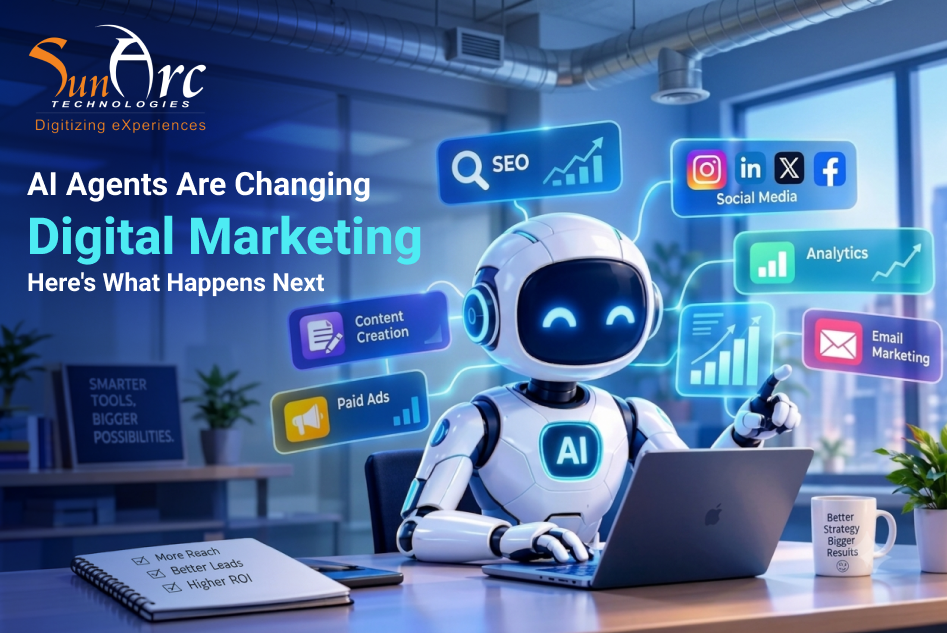
Digital marketing has gone through changes brought by new technology—search engine optimization, social media ads, marketing automation tools and now generative AI content creators. Each of these changes improved how things were done. The people in charge still made the final decisions. That’s changing now. A new kind of software known as AI agents is stepping in to make decisions on its own. This isn’t a small upgrade. It’s a shift in how digital marketing teams work.
This blog looks at what AI agents in marketing really mean, why 2026 is the turning point for their use and what marketing leaders should be ready for as this technology grows more advanced.
Understanding the Shift: From Automation to Autonomy
For years automation in marketing meant simple rule-based actions. If a user left a cart an email would be sent three hours later. These systems followed fixed logic. They didn’t adapt. They didn’t think. They just followed instructions.
Now AI agents do something. They understand context. They weigh options. They act to reach a goal. They can change direction when new information comes in—without someone telling them what to do at every step.
Experts call this marketing. The difference is important. A martech leader recently said that agentic AI is about systems that take semiautonomous and even full autonomous actions to achieve results.. Getting to that point isn’t just about the tools. It’s about data, systems that talk to each other, strong governance rules and trust within the organization that AI can make smart decisions.
The technology is here. The real challenge is whether companies are ready to use it in a way.
The growth is fast. The market for AI is expected to hit about $11.79 billion. This isn’t something a few early adopters are testing. It’s moving into the core of enterprise software including every part of the marketing stack. It’s not a trend. It’s happening now.
What AI Marketing Agents do
It is helpful to be clear about what AI Marketing Agents can do instead of making big claims. Today, AI Marketing Agents can do more and more:
Allocate and rebalance ad spend over time. Bid automation has been around for a time, but its reach is growing. By 2026, automation will go beyond just bidding to select content, find target groups, and divide money across different channels. Systems will spot trends that marketers have not noticed yet.
Personalize at a level that earlier tools could not. Instead of just putting a first name in a subject line, AI Marketing Agents use deep data analysis to guess how a customer will act and make every interaction better. AI Marketing Agents find patterns that help predict product sales, change price plans, and improve lead scoring accuracy. In practice, this is landing pages that change words and offers based on where they came from and what they want, and email chains that send at different times and use different content for each person.
Handle customer interactions as people become more okay with it. Many marketers think people still dislike AI help. That is not true. A CSG survey shows that 77 percent of people worldwide feel fine with AI answering a question or solving a problem. That comfort removes the hurdle for using AI Marketing Agents in support lead checking and even early sales talks.
Operate inside agentic commerce settings. Some of the examples now involve the actual buying process. Agentic systems create a kind of online shopping where digital AI Marketing Agents talk, pay, and answer questions right away, giving a smoother and smarter customer path by working with CRM, payment gateways, and data tools. BCG analysis that many people read says this move to autonomous work can raise efficiency by 25 to 40 percent.
All of these abilities show why AI Marketing Agents are no longer a buzzword but a real budget item for both medium and large companies.
The Best AI Agents for Marketing: What to Look for in 2026
Because many tools say they have “agentic” features, marketing leaders who are looking for the Best AI Agents for Marketing should not just believe the marketing language. They should look at some specific things:
- Data Integration Depth: An agent is only as good as the data it can use. Agents that connect directly with CRM, ad platform and analytics data depending on manual uploads or old files—create much better results.
- Guardrails: The powerful systems let marketers set clear limits: spending limits, rules for brand voice and approval steps for important actions. An agent that does not have these limits is a danger, no matter how smart it is.
- Explainability: When an agent moves money or changes a targeting plan marketers must know why. Systems that show the thinking behind decisions, not the results help build trust in the organization so more tasks can be given to the agent.
- Ability to work across channels: The benefit of AI Agents for Performance Marketing comes from working across areas. An agent that can see how paid search, paid social and email are doing all at once will do better than tools that only work in one area.
- Testing Environment: Advanced systems let marketers use agents in a space before letting them work in real situations. This lowers the chance of mistakes when the agent is working on its own.
AI Agents for Performance Marketing: A Closer Look
Performance marketing—the area that cares the most about results that can be measured—has been one of the most excited groups to try tools that work on their own. The idea makes sense: performance campaigns create a lot of organized information (like clicks, sales and cost per sale) which is the kind of environment where self-running tools do best.
AI Agents for Performance Marketing are being used more and more to:
- Test and change ads all the time based on what people’re doing right now instead of waiting for planned A/B tests
- Move money between ads and places in one day instead of waiting a whole week to do it manually
- Find parts of the audience that are not working well and move money before a person even sees it on a screen
- Guess which people are most likely to buy and focus on them first
The idea that this saves time sounds good and the numbers show it works: most marketing teams waste five to ten hours a week on things that AI agents can now take care of. Performance marketers should not think of agents as completely “done and forgotten.” The companies that get the results are the ones that let the agents work but also make sure people check in regularly. They look not at the results but at whether the ideas the agent is using still make sense as things change.
AI Marketing Agents for Businesses: Scaling Considerations
Enterprise and mid-market businesses have a different way of thinking about adopting new tools than individual marketers or small teams trying out one tool. For AI Marketing Agents for Businesses to provide lasting value three important requirements within the organization usually matter more than how advanced the agent is.
Data quality comes before automation: An agent that makes choices based on scattered or incorrect data will just speed up decisions. Companies that get the results usually spent time gathering and improving their marketing data before using automated decision-making.
Shared responsibility across teams: AI Marketing Agents for Businesses are starting to affect areas such as sales, customer support and finance when it comes to spending money. This means the people in charge cannot all be in the marketing department. Clear roles and ways to handle problems stop AI Marketing Agents for Businesses from working in areas where no one is watching.
Managing change, not just using the tool: Letting an AI Marketing Agent for Businesses make choices that were once made by a marketing manager or someone who buys ads requires a shift in how people think. Teams need to know what the AI Marketing Agent for Businesses is doing, why it is doing it and what options are available if it makes a mistake.
What Happens Next: Five Predictions for the Road Ahead
- Agent Optimization will become a field. Like SEO helped brands appear in searches, a new field is growing that helps brands show up well in AI recommendations and in transactions between AI agents.
- Hyper-personalization will become a standard, not a feature. As AI changes content, on the fly the edge will move from “can you personalize” to “how smart and ethical can you personalize.”
- Governance frameworks will grow with technology. Expect businesses to create rules AI usage charters, spending limits, required human review steps—as they decide how much freedom to give AI.
- The talent profile of marketing teams will change. Jobs that do campaign work will shrink, while jobs that oversee AI agents design prompts and workflows and build data structures will grow.
- Consolidation will happen among marketing AI vendors. As AI skills become basic expect fewer but more connected platforms to replace today’s separate solutions.
Final Thoughts:
AI Agents in Digital Marketing are not a temporary trend that will disappear with the next big excitement. They represent a lasting change in how marketing decisions are made. The companies that will benefit the most are not always the ones that jump into the technology first. It’s the companies that focus on the basics—data, strong governance and the courage to rethink how work gets done. They don’t automate old processes. That’s what makes AI trustworthy and powerful in the world.
Making this transition is rarely a plug-and-play exercise. That’s where an experienced technology partner like SunArc Technologies becomes valuable. With over 23 years of experience delivering software e-commerce and digital marketing solutions, across Singapore and India SunArc Technologies brings the -disciplinary expertise that agentic marketing adoption demands—spanning enterprise systems, cloud solutions and dedicated digital marketing services.